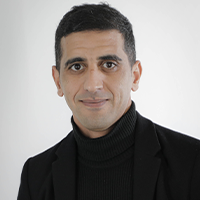
ProgramMAIN CONFERENCES Patrick Perré
Bio-based materials for construction: resources, advantages and combination with geo-based materials. Bio-based materials have many qualities: carbon footprint, thermal insulation, tensile strength, water regulation, thermal inertia through phase change, etc. However, as they are perishable materials, they are more difficult to use than mineral materials. Furthermore, they are produced by ecosystems, which are both solutions to climate change and the first victims of climate change. After an introduction on current and projected renewable carbon production, the conference will attempt to provide a fairly comprehensive overview of the advantages and disadvantages of bio-based materials and the benefits of combining them with geo-based materials. The aim is to show how these materials can offer solutions to construction challenges, particularly in response to climate change, both in renovation and new construction. Indeed, after talking at length about energy-inefficient buildings, the media are now talking a lot about boilers during heatwaves: our societies have finally realised the need to work on thermal comfort in summer. Biography: A specialist in wood and bio-based materials and an expert in coupled heat and mass transfer in porous media, Patrick Perré now also works on bioactive systems and biotechnologies, particularly the biodegradation and bio-manufacturing of bio-based materials. Initially a research fellow at the CNRS, then a professor at AgroParisTech Nancy, where he headed an INRAe joint research unit, he joined CentraleSupélec in 2011 to restructure a 70-person laboratory (LGPM) focused on renewable resources. Since 2015, he has headed the CentraleSupélec Chair in Biotechnology. With an annual budget of over €3 million, this group of more than 40 people applies the concept of digital twins to the sustainable production of materials, energy and molecules. Author or co-author of more than 300 articles in peer-reviewed journals (h-factor: WoS = 43, Google Scholar = 56), Patrick Perré has received three international awards and has numerous international collaborations.
Impact of hygric phenomena on the hygrothermal behaviour of bio-based and geo-sourced materials: from experimentation to modelling Biography: Florence Collet is a professor at the University of Rennes - Civil Engineering and Materials Engineering Laboratory (LGCGM). A specialist in bio-based and geo-sourced materials and hygrothermal transfers, Florence Collet has participated in several national and international projects and has been involved in various working groups and technical committees. Her work focuses in particular on:
Hygrothermal behaviour of bio-based building materials: physical approach and application prospects Biography: A graduate of École Polytechnique (X87) and École Nationale des Ponts et Chaussées, Professor Philippe Coussot is a physicist and specialist in rheology and complex fluid mechanics. His work focuses in particular on threshold fluids, suspensions, flows in porous media and rheometry using magnetic resonance imaging. After starting his career at Cemagref and then at the Laboratoire Central des Ponts et Chaussées, he became a professor at École des Ponts ParisTech, where he heads the ‘Porous Media’ team at the Laboratoire Navier. Author of numerous reference books and scientific publications, he is internationally recognised for his contributions to the physics of complex materials. He has received several major awards, including the CNRS Silver Medal and an ERC Advanced Grant. Nicolas Vernoux-Thélot
Architectural Approaches to Bio-based and Geo-sourced Materials for Low-Carbon Buildings As part of its National Low-Carbon Strategy, France has been committed to drastically reducing its greenhouse gas (GHG) emissions over the past decade. Since the construction sector is among the most polluting, it must increasingly integrate low-carbon materials. Through selected projects and research programs, Nicolas Vernoux-Thélot will demonstrate the benefits of using bio-based and geo-sourced materials, as well as their potential for hybridization with waste resources and for integration into passive and innovative building systems. Case studies will include raw earth, water-based systems, refractory bricks, sargassum, recycled wood, thermosensitive envelopes, and radiation-shielding materials. Yassine El Mendili
Microstructure and performance of bio-based and geo-based materials Bio-based and geo-based materials exhibit mechanical and hygrothermal properties that are strongly influenced by their microstructure. I will show how multi-scale porosity, interfaces, and implementation parameters (particle size, compaction, water content, fibers/fillers) simultaneously govern mechanical properties (rigidity, strength, damage) and hygrothermal properties (sorption, vapor/liquid transfer, thermal conductivity). Low-carbon formulation and stabilization approaches will be compared with characterization methods (microstructure and coupled tests) in order to identify optimization levers. The objective is to illustrate how these indicators can guide design to improve the trade-offs between strength, hygrothermal comfort, and durability, while reducing the carbon footprint. Biography : Yassine EL MENDILI is a professor (Dr.) and head of the “Materials for Sustainable Construction” team at ESTP (Institute for Research in Construction). His work focuses on low-carbon, bio-based, and geo-based construction materials (stabilized raw earth, biocomposites, alternative binders, formulations based on co-products and recycled resources). He develops approaches linking microstructure, hygrothermal transfers, and mechanical performance/durability, combining formulation, implementation, and multi-scale characterizations (XRD, Raman, FTIR, FRX/EDX, sorption/DVS, conductivity, mechanical and electrochemical tests). He leads collaborative academic and industrial projects aimed at decarbonization and circularity of materials. He is also an expert evaluator for the European Commission on devices dedicated to technologies and innovations for low-carbon building materials, including sustainability and CO₂ storage potential. |